- Electric charge
- —
- Baryon number
- —
- Strangeness
- —
- Mass
- —
Chapter III · The Hadron Builder
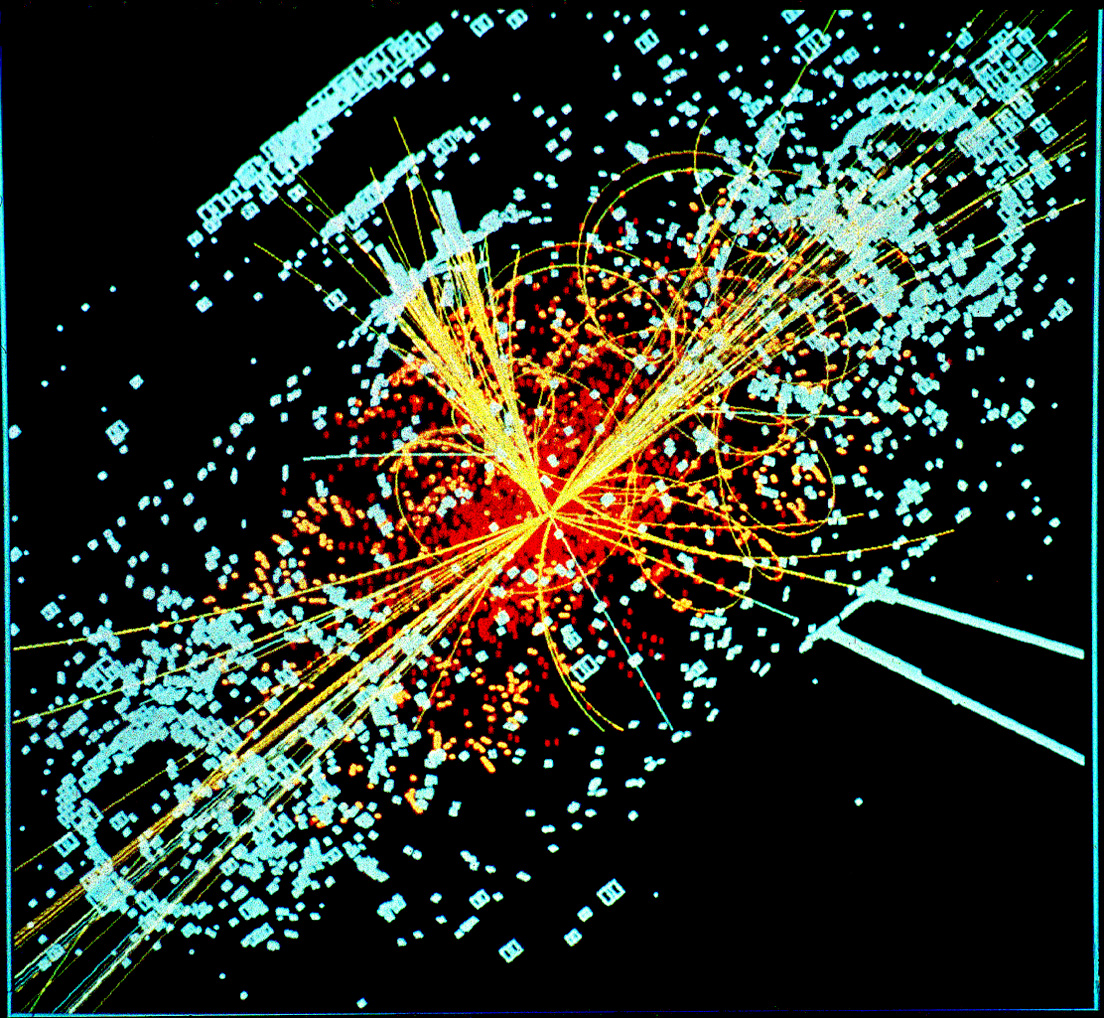
Everything heavy around you — every proton and neutron in every atom — is really a tiny bag of quarks. We call those bags hadrons. A proton is three quarks. A neutron is three quarks. The pion that carries the nuclear force is two.
Here is the strange part. You can crack an atom open to find its nucleus. You can crack the nucleus open to find protons and neutrons. But when you try to crack a proton open and pull one quark free, it doesn't come out. Pull harder and the universe spends your energy making new quarks instead — so you end up with two bags, never one loose quark. This isn't a limit of our tools. It's a law. Physicists call it colour confinement, and finding out why it's true is what this chapter is about.
Nature allows just two kinds of bag. A quark paired with an antiquark is a meson — light, and usually short-lived. Three quarks together is a baryon — the family the proton and neutron belong to. That's it. No one has ever found a stable one-quark or four-quark bag sitting on its own.
What decides which bags are allowed? A brand-new kind of charge, unrelated to electric charge, that quarks carry and electrons don't. Physicists nicknamed it colour — and it is a nickname, a label, nothing to do with the colours you see. It comes in three kinds they call red, green, and blue. The one rule: a bag can only exist if its colours cancel to colourless. Red plus anti-red cancels (that's a meson). Red plus green plus blue cancels, the way light does (that's a baryon). Anything that doesn't cancel is forbidden.
Meet the building blocks
A quark. Charge +⅔. Never seen alone — only inside a bag.
A quark. Charge −⅓. Two up + one down makes a proton.
Now build a bag of your own — and try to break the one rule.
Now build them yourself. Pick a mode, tap quarks into the well, and watch the proton, the pion, the lambda assemble — then try to build something nature forbids and see the forge refuse it.
Quarks are never found alone. Pick a mode, then tap quarks from the palette to drop them in the well. A combination only exists in nature when its colour charges cancel to colourless — a colour + its anticolour (meson), or red + green + blue (baryon). Try a challenge, or invent your own.
§ Colour charge isn't a literal colour — it's the “charge” of the strong force, and it comes in three kinds physicists label red, green, blue. The strong force only binds combinations that add up to colourless: a colour + its anticolour (a meson) or all three colours together (a baryon). Anything else is never seen alone in nature.
§ Try to build something forbidden — two ups, or a lone quark, or a quark with a mismatched anticolour. The forge will tell you it is not observed in nature, because the strong force confines colour: only colourless states can exist as free particles. That single rule is why protons and neutrons are the building blocks of everything around you.
Fair question. The answer came from a kind of X-ray. In 1968, at Stanford, physicists fired a beam of electrons straight into protons — far harder than anyone had before. If a proton were a soft, uniform blob, the electrons should have glanced off gently. Instead, every so often one ricocheted at a wild angle, exactly as if it had hit something tiny and hard deep inside.
Three hard little lumps, in fact. The proton wasn't a blob — it had parts. Those parts were the quarks Gell-Mann and Zweig had sketched on paper four years earlier. We've still never pulled one out. But we've felt them in there, the way you can feel marbles inside a sock without opening it.
The force between two quarks behaves backwards from gravity or electricity. Those forces weaken with distance. The strong force does the opposite: pull two quarks apart and the attraction stays roughly constant, like a stretching rubber band that never goes slack. Keep pulling and you pump in energy without limit — until there's enough energy to conjure a fresh quark–antiquark pair out of the vacuum (Einstein's E = mc², run in reverse). The band snaps, and each loose end instantly caps itself with a new quark.
So you never get one quark. You get two bags. Theorists named the flip side of this asymptotic freedom — quarks rattle around almost free when they're packed close, and clamp tight only when you try to separate them. Working that out (Gross, Wilczek, and Politzer, 1973) earned a Nobel Prize, and it's the reason the forge above will never let you keep a lone quark in the well.
From a zoo to three quarks
How did we go from a chaos of a hundred particles to the simple rule you just played with? It took a guess from a line of Joyce, a missing slot in a pattern, and one very hard beam of electrons.
A zoo opens. New particles pour out of cosmic rays and the first accelerators — pions, kaons, lambdas, sigmas, a bewildering menagerie. By the late 1950s there are over a hundred 'fundamental' particles. Something is badly wrong: fundamental things aren't supposed to come in hundreds.
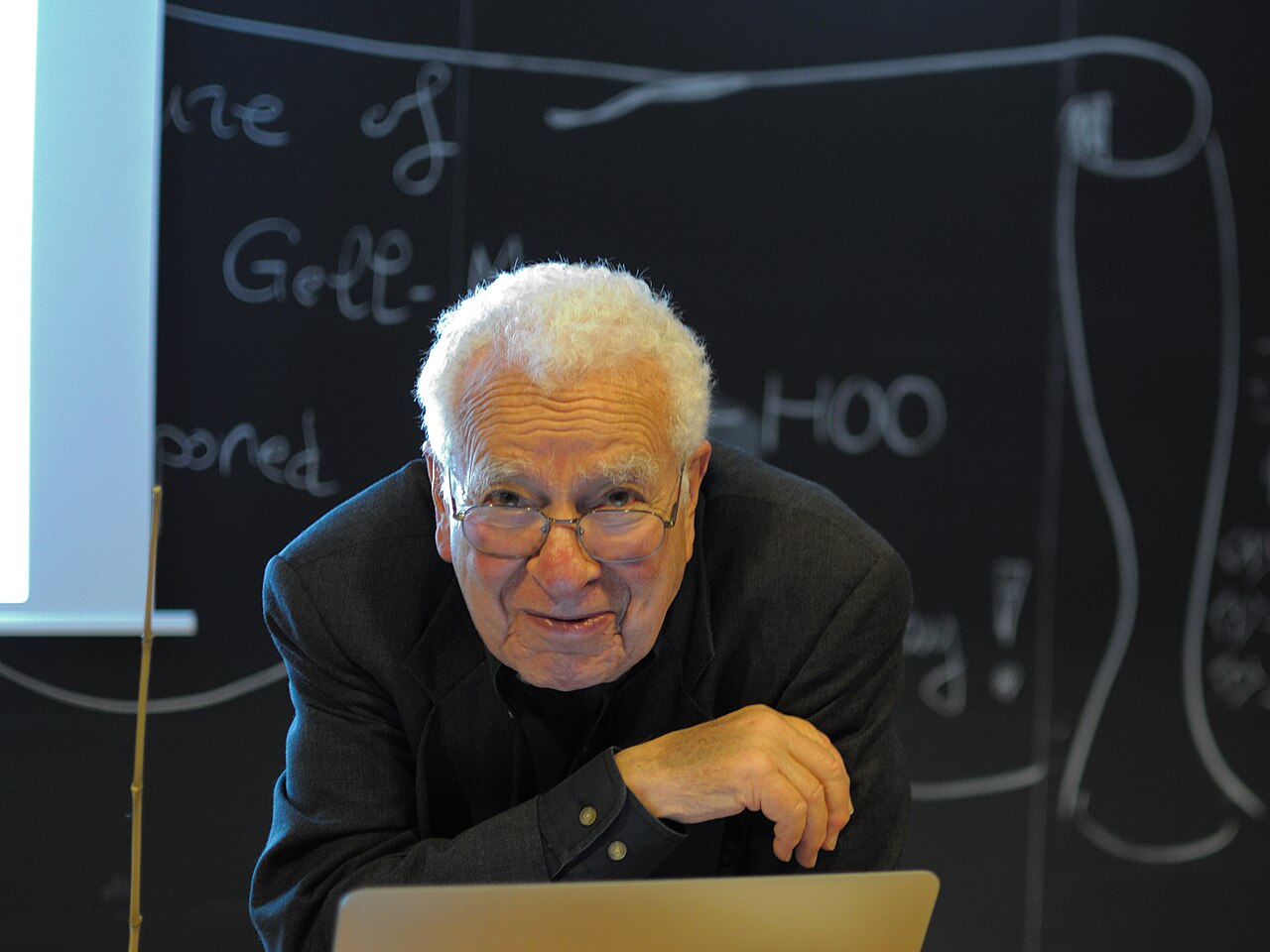
One slot in a pattern of ten is empty. Gell-Mann predicts the missing particle — the Ω⁻ — and even pins down its mass. A bold call: name a thing no one has seen, then dare the experimenters to find it.
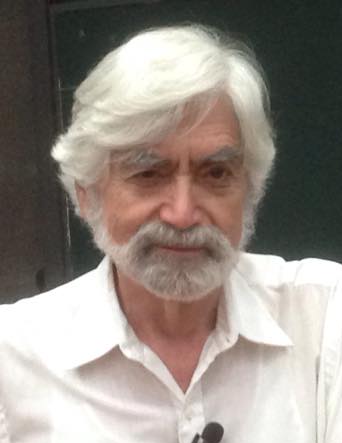
The reaction of the theoretical physics community to the ace model was not benign. George Zweig, recalling 1964
The Ω⁻ is found at Brookhaven — right where the Eightfold Way said it would be. The patterns are real. But are the quarks inside real, or just bookkeeping? Most physicists assume bookkeeping: a thing you can never isolate hardly seems like a thing.
At Stanford's two-mile accelerator, a team led by Richard Taylor (with Friedman and Kendall of MIT) fires electrons hard into protons. Electrons bounce back at sharp angles — the proton has tiny, hard lumps inside. The quarks are not bookkeeping. They are there.
Feynman, visiting SLAC, models the proton as a swarm of pointlike 'partons' — soon understood to be the very quarks Gell-Mann and Zweig drew. Two paper ideas and one beam of electrons have just met.
Gross, Wilczek, and Politzer crack the deepest puzzle: asymptotic freedom. The strong force grows with distance, so quarks can never be pulled free — confinement, finally explained, not just observed. (Nobel Prize, 2004.)
Friedman, Kendall, and Taylor share the Nobel Prize for the experiments that revealed quarks inside the proton — the moment the 'bookkeeping' became matter.
Every proton in your body is a flicker of three confined quarks, bound by colour that must always cancel to white. We have mapped them, weighed them, and proven they're real — and we will never, ever see one alone.
Hold a pebble. Every proton in it is three quarks that have never been alone and never will be — held together by a force that grips tighter the harder you pull. The everyday solidity of the world is, underneath, a law against loneliness.
We've built the bags. Next: the rules that govern how their contents push, pull, and transform — drawn as the simplest pictures in physics. That's where we go next.